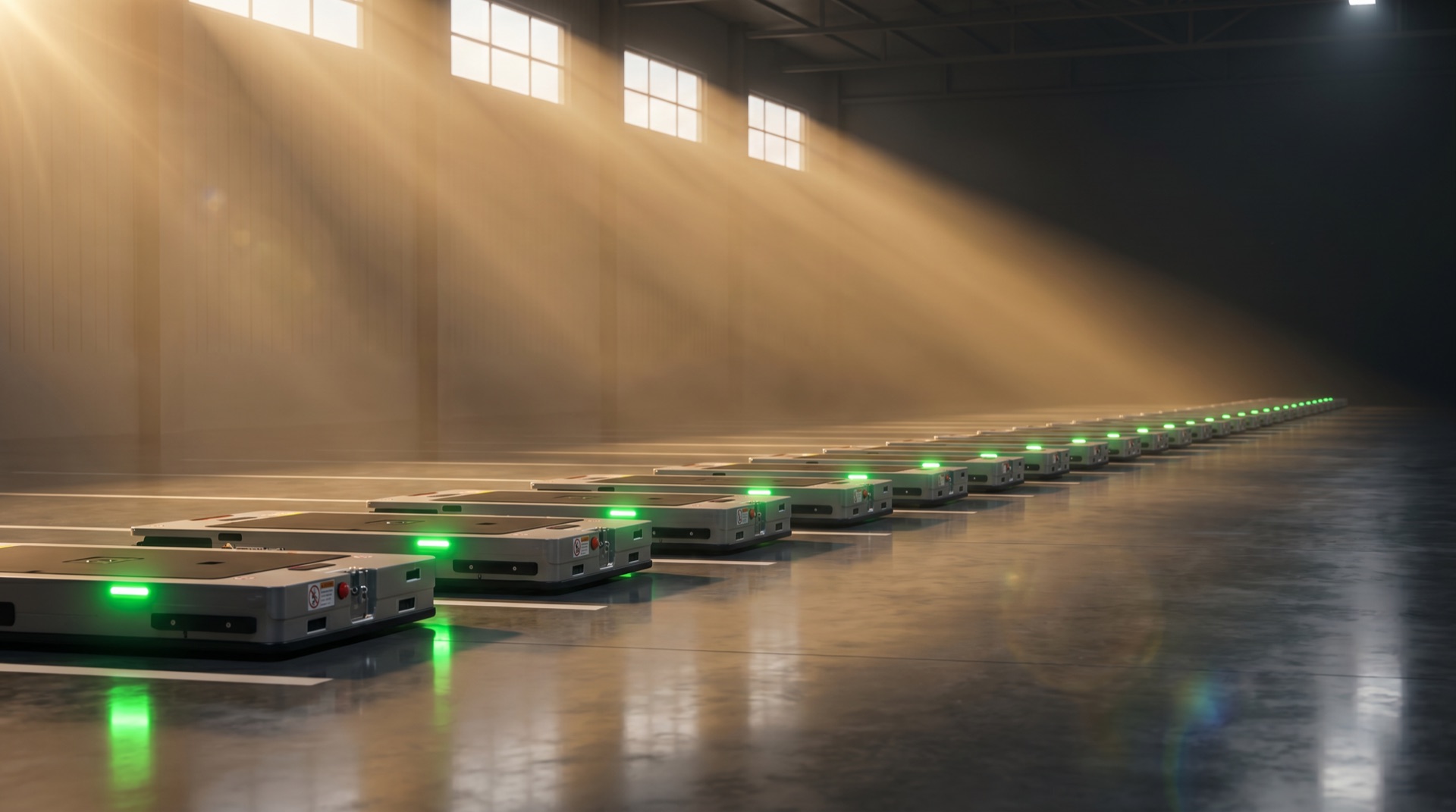
Autonomous material transportation for factories, warehouses, and 3PLs. Reserve the capacity your operation needs and pay for verified completed moves.
Illustrative workflow · Approved routes, loads and handoffs.
No robot CapExBuy transportation capacityPredictable unitOne price structure per laneVerified deliveryEvery move leaves a recordLifecycle managedFleet, software, and support
The transaction layer
Request. Assign. Move. Verify.
Your team requests an outcome. MaaS assigns an available transport resource within the approved scope, tracks the mission, and closes it when the load reaches its approved destination.
01
Request
Operator button, API, WMS, MES, PLC, or a scheduled replenishment rule.
PickupLine-side supermarket
02
Assign
Match the lane, load class, priority, availability, and handling type.
AssignmentApproved capacity
03
Move
The assigned transport unit executes the approved material flow.
StatusIn transit
04
Verify
Delivery, timing, outcome, exceptions, and billable status are recorded.
OutcomeCompleted
Mission sources
Operator buttonAPIWMSMESPLCSchedule
DropletAI MaaS
Dedicated capacityAvailable for your planned peak.
Define the unit correctly
One move is a delivered load unit.
A completed material move is one standard cart, pallet, tote, roll, rack, or fixture successfully delivered from an approved pickup point to an approved destination.
Robot-caused failure?Not a completed move. Not billable.
DropletAI MaaS
The transportation layer above the robot.
MaaS accepts the job, assigns capacity, manages the service level, and meters the outcome. The underlying equipment can change without changing what your operation buys.
Multi-fleet orchestration path
Lane, load, priority, and peak-capacity rules
Mission ledger, exception codes, and SLA evidence
One move. One traceable record.
01
Request acceptedApproved pickup, destination and load class
02
Capacity assignedResource, priority and service window recorded
03
Handoff confirmedDelivery time and destination acknowledgement
04
Move closedOutcome, exceptions and billable status recorded
One accountable operator
You own the operation. We own the transportation.
Your team defines production priorities and safe operating rules. DropletAI is accountable for the transport system that executes them.
Your operationSet the rules
Approved pickup and drop-off points
Material priorities and production windows
Load readiness and handoff standards
Clear aisles and safe shared-space behavior
Operating SLA
DropletAIRun the network
Assignment & coordination Fleet & charging Systems integration Monitoring & metering Maintenance & spares Support & updates
Cost per material move
Start with the work. Not the robot count.
Estimate the labor tied to one repeatable movement. Final service pricing depends on route, payload, handoffs, peak capacity, integration, and SLA.
Predictable economics
Reserved capacity + completed moves.
Your operation gets the responsiveness of an on-demand network. The contract reserves the dedicated capacity required for forecast volume and planned peaks.
No surprise surge pricing.Standard, reserved-peak, and priority service levels are contracted in advance.
01
BaselineMinimum movement commitment
Supports the dedicated transport capacity installed in your facility.
02
UsageVerified completed moves
Volume can scale above the commitment with a predictable lane and load structure.
03
PeakReserved surge capacity
Plan seasonal, launch, and shift peaks without volatile on-the-day pricing.
Where the model starts strong
Repeatable flows with real travel behind them.
The best first lanes combine distance, frequency, multiple shifts, and standardized pickup and drop-off behavior.
Longer manual cycles
More travel time makes avoidable cost per move easier to see.
High repeat frequency
Steady demand creates a measurable dispatch and utilization baseline.
Multi-shift operations
Dedicated capacity can work across more of the operating day.
Standardized handoffs
Approved stations and load standards make outcomes auditable.
When your customer revenue scales per pallet, case, order, or shipment, autonomous transport cost can scale with the work too.
Choose the right economics
How would you prefer to buy autonomous transport?
DropletAI can structure the system around outcomes, a fixed managed fleet, or customer ownership. The right answer depends on your flow—not our inventory.
Selected starting pointCompleted moves
Commercial structure follows utilization, peak demand, contract horizon, and who is best positioned to own the asset risk.
Because the service unit is transportation output. DropletAI controls dispatch, uptime, maintenance, and equipment substitution while your team buys reserved capacity and completed delivery outcomes.
What happens when a mission fails?
Robot-caused failures are recorded as failed and are not completed billable moves. Customer-caused blockages and excessive wait conditions are separated with timestamps and exception codes.
Do we need a WMS or MES first?
No. A first flow can begin with operator calls, buttons, schedules, or a lightweight API. Deeper WMS, MES, PLC, and ERP integrations can follow after the operating flow is proven.
Does the contract count as off-balance-sheet service?
That depends on the contract, identified assets, substitution rights, and who controls use. Your accounting advisor should assess the final arrangement under the applicable standards.
Start with one flow
Bring us one lane. We’ll model the movement.
Share average and peak moves, trip time, payload, pickup and drop-off points, and the current transport method. We’ll assess operational fit, reserved capacity, and commercial options.